
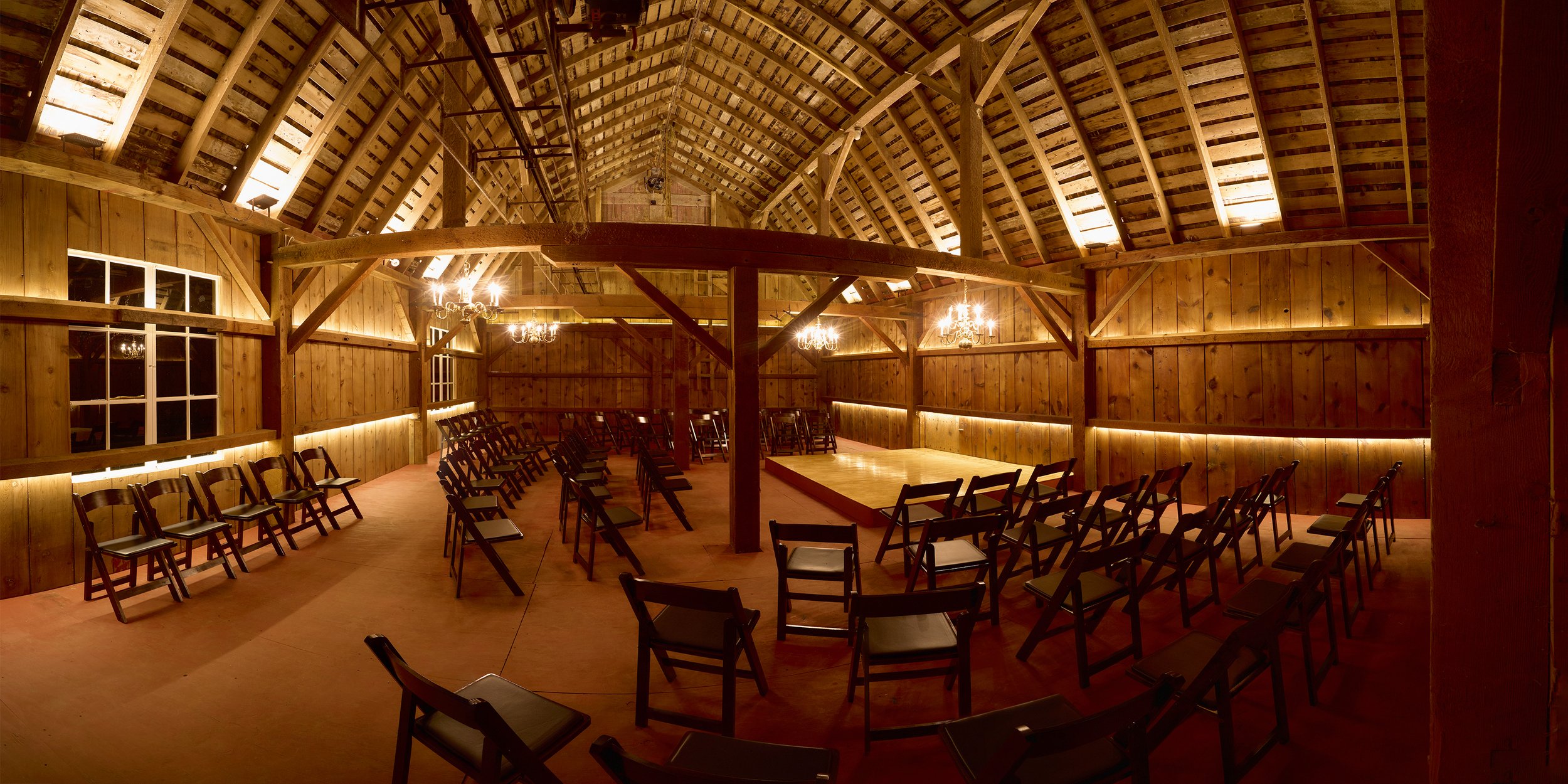
Mainstage: Jefferson’s Playlist
Program Information
Location: Tallgrass Hall
Concert Time: 4pm
Duration: 1h20m
What would Thomas Jefferson program if he were an artistic director?
Jefferson was arguably the most musically serious of the founding fathers. He practiced violin three hours a day as a young man, collected thousands of pages of sheet music from across Europe, and built a music salon at Monticello furnished with a piano, harpsichord, violins, cello, and guitar. He once called music "the favorite passion of my soul" — a remarkable statement from a man whose passions included architecture, science, agriculture, and the founding of a nation. He attended concerts and operas in Paris while serving as minister to France, acquired scores by Corelli, Vivaldi, Haydn, and Bach, and insisted that his daughters and granddaughters study music as a lifelong discipline. According to family legend, he even won the hand of his wife Martha by playing a violin duet with her that was so beautiful two rival suitors quietly left the house.
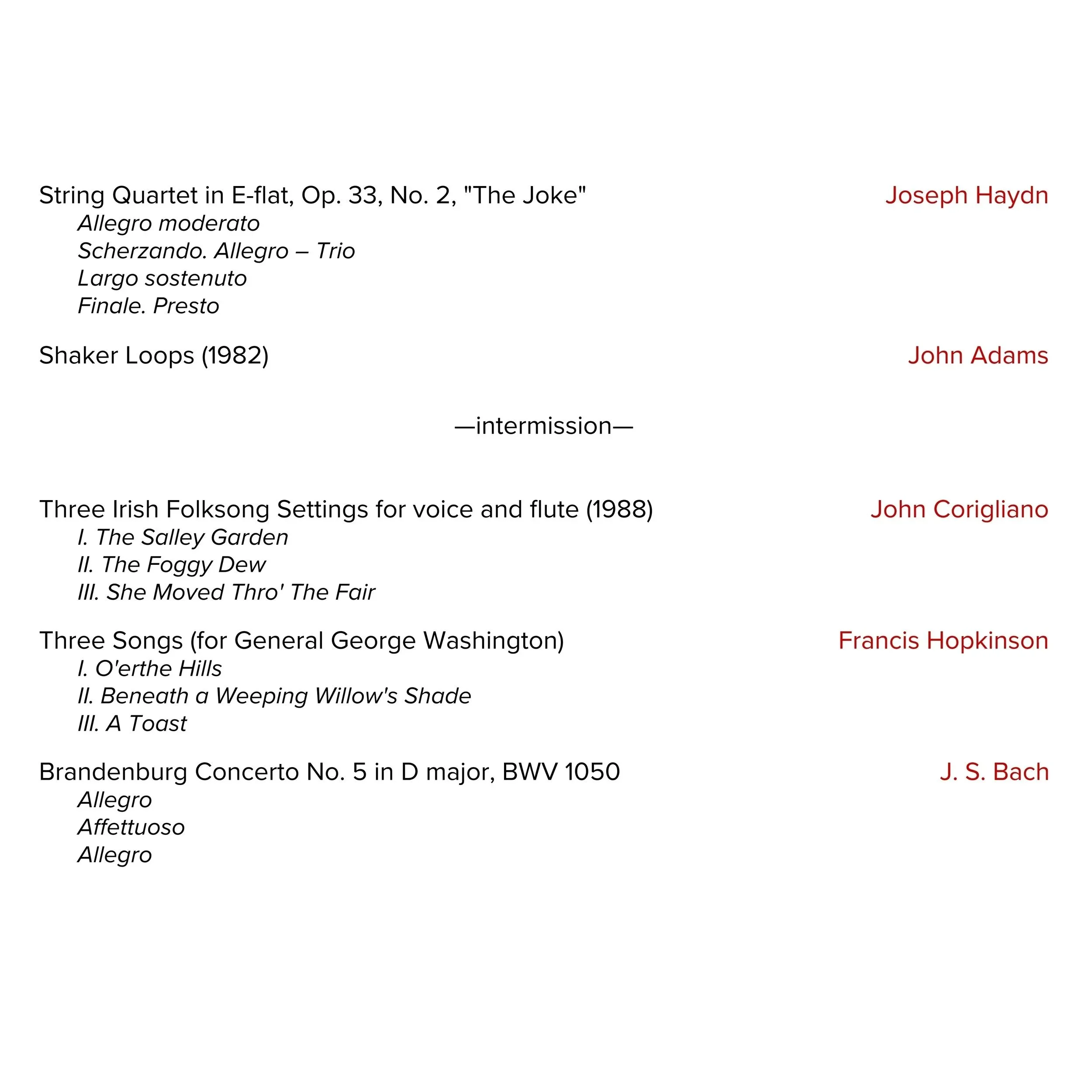
"Jefferson's Playlist" takes that musical life as a starting point and builds a concert around it. The program includes music by Haydn and Bach, two composers Jefferson especially admired. Haydn's music was everywhere in late 18th-century America — performed in Philadelphia concert halls, copied into personal music books. Bach (in Jefferson's case, likely Johann Christian Bach, the youngest son) represented the elegant, cosmopolitan European tradition that Jefferson saw as a model for cultural life in the young American republic.
Alongside them is Francis Hopkinson — Jefferson's friend, fellow signer of the Declaration of Independence, and, by his own claim, the first native-born American to produce a musical composition. Hopkinson was a Philadelphia lawyer, harpsichordist, and amateur composer whose 1759 song "My Days Have Been So Wondrous Free" is the earliest surviving American secular western composition. In 1788, he published his "Seven Songs for the Harpsichord or Forte Piano" and dedicated them to George Washington, who later appointed Hopkinson to the federal bench. Hopkinson's songs are modest, graceful, and sentimental. Hearing them alongside Haydn and Bach puts them in the exact context their composer would have understood: an American voice joining a European conversation.
The concert also includes a modern counterpart in John Adams' Shaker Loops. Written in 1978, Shaker Loops is one of the landmark works of American minimalism — a piece for strings built on repeating, oscillating patterns that gradually build in intensity and complexity. The title carries a double meaning: "loops" refers to the tape-loop techniques of minimalist composers like Steve Reich, while "shaker" refers both to the trembling of the strings and to the Shaker religious sect, whose worship included ecstatic, physically intense communal dancing. Adams grew up near a defunct Shaker colony in New Hampshire, and the piece channels something of that energy — the sense of repetitive physical motion tipping over into transcendence. Placing it in a program alongside Haydn and Hopkinson creates a striking arc: from the music Jefferson actually played, to a contemporary American work that draws on some of the same spiritual and physical impulses that shaped early American life.
Together, these pieces sketch something larger than any single composer's playlist. They trace a line from the European traditions that Jefferson imported and championed, through the first tentative efforts at a native American art music, to a living American masterwork that inherits and transforms all of it.