
Mainstage: American Stories
Program Information
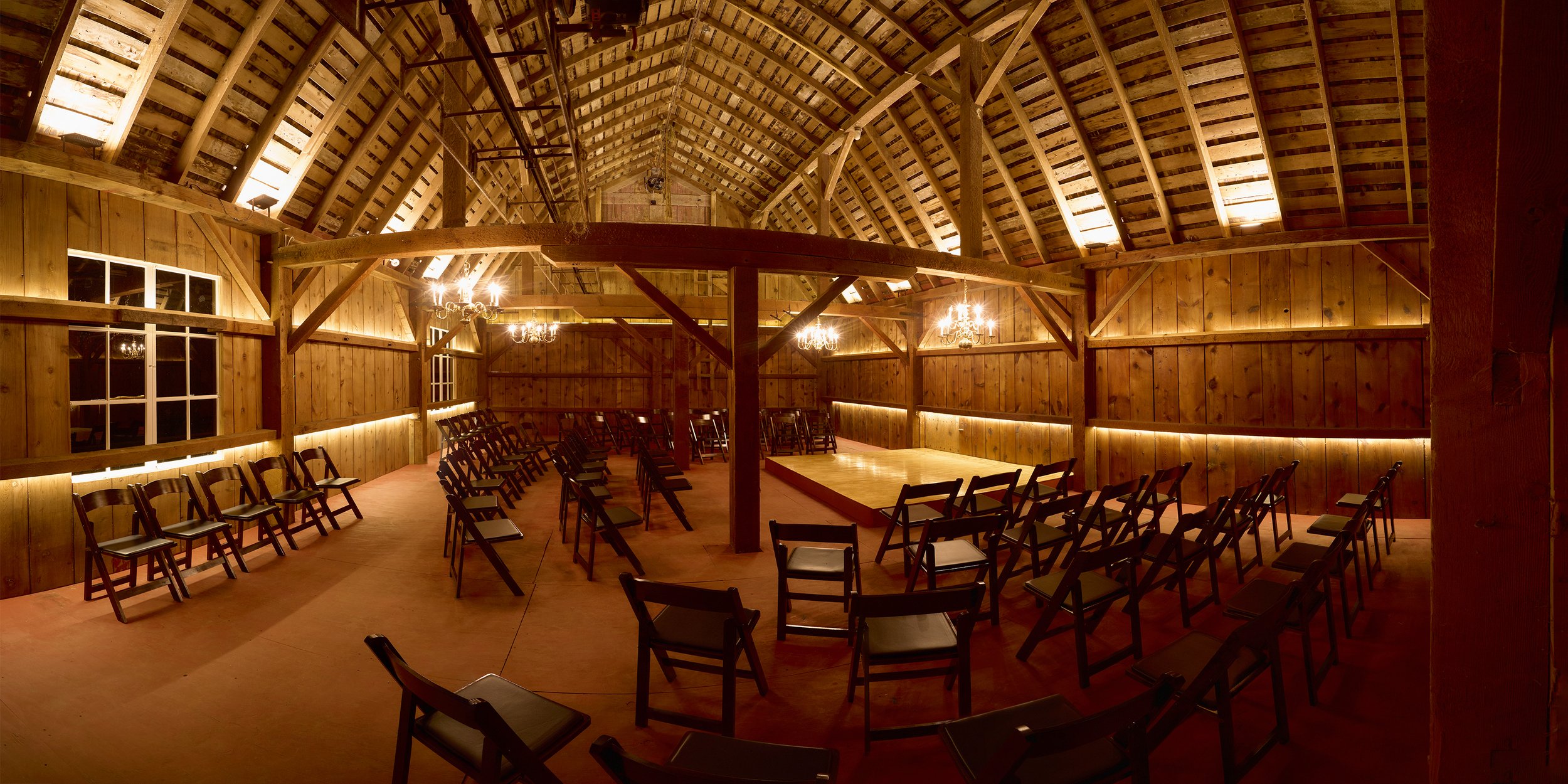
Location: Tallgrass Hall
Concert Time: 7pm
Duration: 1h20m
How is America's story told through music? "American Stories" traces four centuries of American musical life in a single evening — from parlor-room virtuosity to jazz, from the improvisations of an enslaved prodigy to the wide-open harmonies of mid-century Americana.
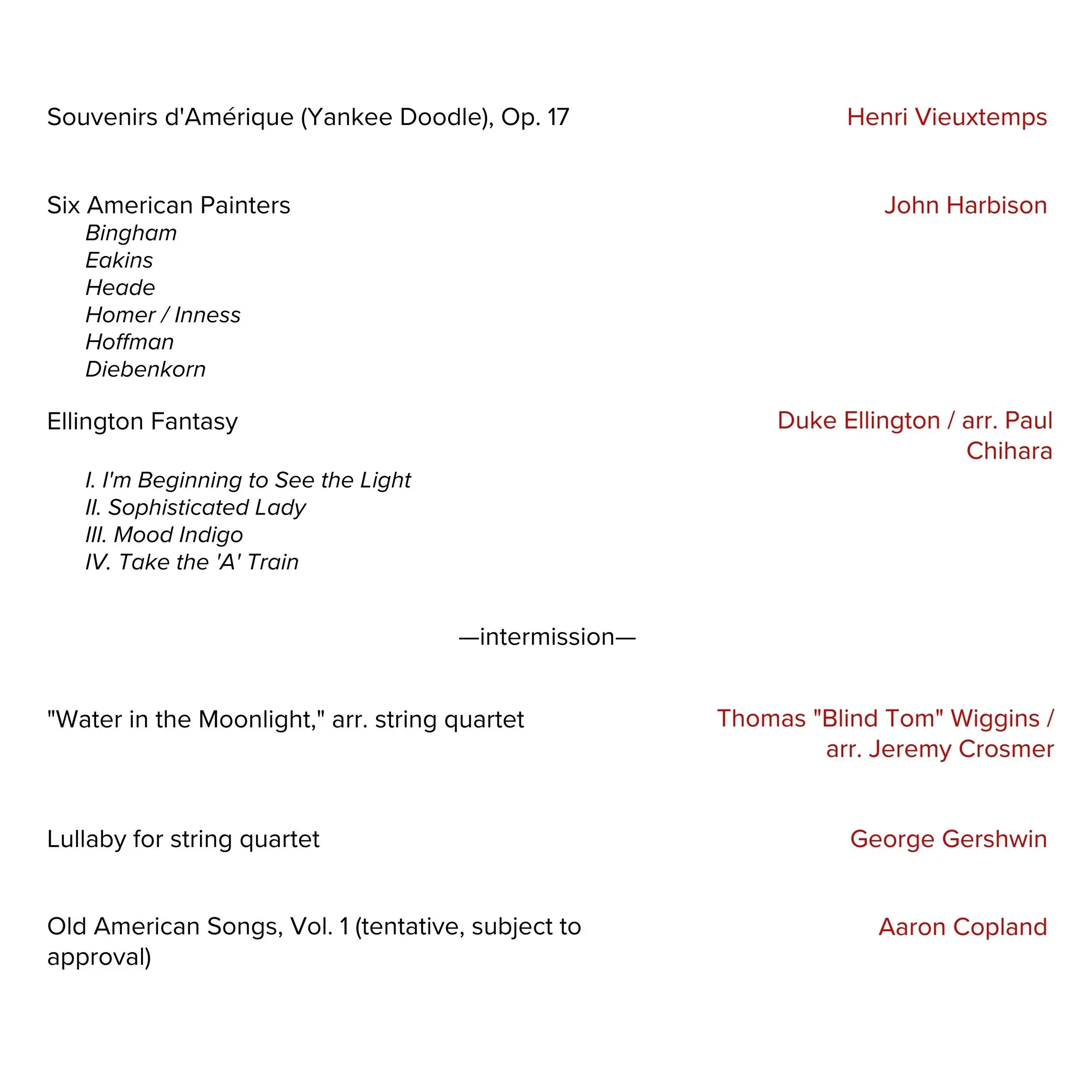
The evening opens with Henri Vieuxtemps's variations on Yankee Doodle. Vieuxtemps was a Belgian violinist who toured the United States in the 1840s and 1850s, and his take on the tune is affectionate and irreverent; treating Yankee Doodle as raw material for virtuosic display, running it through a series of increasingly elaborate transformations.
From there the concert moves to John Harbison's "Six American Painters." Harbison — a Pulitzer Prize–winning composer, MacArthur Fellow, and longtime Wisconsin resident who co-directs the Token Creek Chamber Music Festival — wrote this piece after spending extended time looking at paintings at the Metropolitan Museum of Art. Each of the six movements is named for an American painter: George Caleb Bingham, whose luminous scenes of frontier life along the Missouri River defined the antebellum West; Thomas Eakins, the unflinching Philadelphia realist known for his rowers, surgeons, and boxers; Martin Johnson Heade, whose small, strange paintings of orchids, hummingbirds, and approaching storms carry an almost surreal intensity; Winslow Homer, who moved from Civil War illustration to some of the most powerful seascapes in American art; Hans Hofmann, the German-born painter and teacher whose explosive abstract canvases helped launch Abstract Expressionism in New York; and Richard Diebenkorn, whose late "Ocean Park" series turned the light of the California coast into vast, quiet fields of color. Harbison doesn't try to illustrate specific paintings. Instead, each movement captures something of the painter's sensibility — their palette, their rhythm, their way of seeing. The result is a piece that turns looking into listening.
The first half closes with Duke Ellington, whose jazz standards are heard in new arrangements for string quartet. Beneath the brass and reeds, Ellington’s music is built on sophisticated voice-leading, counterpoint, and harmonic movement that gets new light with a classical instrumentation.
After intermission, the program turns to Thomas "Blind Tom" Wiggins. Born enslaved in Georgia in 1849, blind from birth, Wiggins was a self-taught pianist who could reproduce virtually any piece of music after a single hearing. By the 1860s, he was the highest-paid American performer of any kind — more famous than any opera singer or concert pianist in the country. His original compositions and improvisations are dense, unpredictable, and full of imitations of natural sound: rainstorms, birdsong, the rhythms of machinery. They don't fit neatly into any tradition, and they remain some of the most unusual and affecting music written in 19th-century America. Here, Wiggins’ piano voice is arranged for strings.
The concert closes with music by George Gershwin and Aaron Copland — two composers who, more than perhaps anyone else, shaped what "American music" sounds like to most people. Gershwin brought jazz harmony and popular song into the concert hall. Copland took folk melodies, hymn tunes, and the open intervals of rural America and turned them into a sound so distinctive it became shorthand for the country itself. Together, they close the evening with music that feels as wide open and complicated as the America.